
The first training session
At the moment, we've had Cuba for 2 months and 1 week, and basic obedience training is in full swing.

5. september 2019 · 2 min read · Canis Hovedkontor · Canis Trondheim
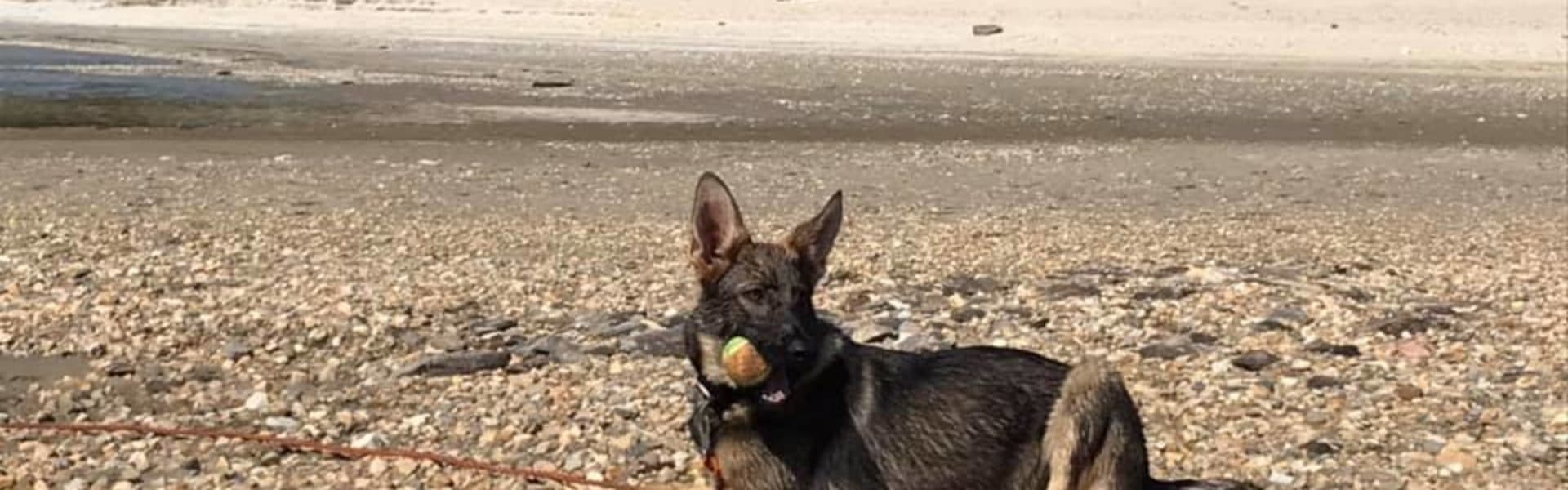
The first training session on a new skill is always interesting. Here's an example of such a session. The criteria were probably too high, but sometimes you have to take a chance and it turned out to be a fun session anyway.
But is this really "the first training session" on "retrieve into heel position"…? Well, yes and no.
The first month I trained, it mostly felt like we just had a collection of "isolated behaviours", which only worked when we trained them individually. But something has changed over the past couple of weeks, and I can now see that several of the behaviours can be combined to a greater degree, and that they're beginning to "work together", even in new situations and combinations.
None of the foundation skills are fully automated yet, but they're now clearly beginning to reach a level where they function in multiple contexts.
In the session above, we build on the following other foundation skills that we've trained before:
- Starting position
- Sit (in front of handler)
- Stay sitting
- "Doggie-Zen"/permission-to-take-treat training
- Grip retrieve from the ground
- Hold retrieve while moving
- Hold retrieve sitting in starting position
- Hold retrieve with visible reward in front of nose
- Turns on the spot
- (Have I forgotten any…?)
If you only look at the training being done in this film, which criteria are being used and the fact that this is "first session with retrieve into starting position", you miss 90% of the picture. Everything new builds on things the dog has learned before.
For example, in this session I let the dog "correct its own mistakes" on a couple of occasions, whilst I myself stand completely calm and wait instead of helping the dog. This wouldn't have been possible if the dog hadn't already
- had several other foundation skills in its repertoire already
- been used to working "voluntarily" without help from the handler.
In short, it's beginning to be quite a lot of training behind what you see in a single training session. And for each new foundation skill you start with, you no longer start with a blank slate. There's already a useful reinforcement history and effects working in the background that make things work (or not).
Written by
Morten Egtvedt
Hovedkontor · Trondheim
Morten Egtvedt founded Canis in 1998. He has written three books and trained over 400 dog instructors in clicker training and reward-based dog training.
Se profil og andre artikler →More to read
· 2. juni 2020 · 4 min
10 dagers challenge på Bli liggende
De siste 10 dagene har jeg kjørt en liten 10 Dagers Challenge på «Bli liggende» med schäferen Cuba (15 mnd).
Morten Egtvedt

· 28. januar 2018 · 2 min
Kriterieplan for å bli en rå klikkertrener
Jepp, det er mye å lære for en ny klikkertrener. Men mange har gått veien før deg, og her er stegene du erfaringsmessig trygt kan følge. Kos deg med treningen og stol på prosessen!
Morten Egtvedt

· 20. juli 2021 · 7 min
Med fare for å virke nyfrelst
Etter at Canisinstruktørkurset ble digitalt, har jeg fulgt det som observatør en rekke ganger. Det høres kanskje litt ekstremt ut, men jeg er faktisk ikke alene.