At risk of sounding like a convert
After the Canis instructor course went digital, I have followed it as an observer multiple times. It might sound a bit extreme, but I'm actually not alone.

20. juli 2021 · 7 min read

Several of those who have participated choose to attend multiple times as an observer, and that says something about the quality of the course. Anyway, that's enough praise. A central part of the course in recent years has been handler psychology and self-training. This has been a theme both in webinars and through practical project assignments that you submit at the end of the course. The handler psychology consists of several webinars, and in the 20/21 course, Dr. Joe Layng also delivered a webinar on emotions with the working title "Emotions and Emotional Behavior". Looking at language and thoughts as behaviour, together with Dr. Susan Friedman's webinars on functional behaviour analysis, expanded the matrix for me.
The self-training project is a project assignment where you use learning theory and various tools to change a behaviour you yourself perform. Different course participants have tackled many different things, from addiction to getting rid of time-wasters. Through this project, you feel in your body how different reinforcement conditions feel, and it can give you an awareness that gives you superpowers when it comes to taking control of your own life, in addition to experiencing the processes you put your dog through (always a useful perspective for those of us who are dog nerds). For my part, I decided to test the concept and see if it could work in relation to quitting smoking. I had quit several times, but usually ended up back on the habit (enough so that my smoking cessation attempts were the standing joke in my friend group). As a ripple effect of the first self-training project, I have changed my diet, sleep habits, exercise habits and shopping habits. The last self-training project I took on was to pick up my master's thesis again, and use the tools I now had to manage to complete that devil of an unfinished project that had hung over me for the last 15 years. And guess what – in spring I submitted it with a good result, and I'm enjoying a significant pay rise as a reward for the effort.
Through the first self-training project, I worked quite systematically according to the recipe Morten laid out in the instructor course:
1) Record the behaviour I wanted to work with (map baseline). The recording mainly involved mapping frequency – how many cigarettes I smoked in a day, and in which situations I smoked.
2) Continue to allow myself to smoke – but when I smoked, I was to be mindful. That is, I was to be fully aware of enjoying the moment the times I chose to have a cigarette. This turned out to be a mistake, because it turned out that I didn't particularly like the taste, and 9 out of 10 cigarettes tasted absolutely horrible.
3) I then used the point sheet that Morten has developed. It is based on token economy, which turns out to work well for me. When I adapted the point sheet to my project, I had to identify key behaviours, and I had to think through what were difficult or important situations, and what required less of me. The former had to give many points (for example, going to the shop without buying cigarettes would give 100 points, and the same applied to the behaviour of going to bed early enough to get 8 hours of sleep), whilst easy behaviours (such as driving a car without smoking or skipping the cigarette after a meal) could give 10–20 points. I should mention that this is just one of several tools suggested on the course, but I used the point sheet because even small points work as reinforcement for me.
4) I had the point sheet saved on my desktop so it was easily accessible, and it was exhilarating to "hunt" points and see the point total increase – for me, this gradually became more important than cashing in the reward I had promised myself at various achieved totals. The first time I reached such a point goal, I cashed in the reward and bought myself a down jacket, but after that the final reward became insignificant to me – the points were what "felt good". The last step was thus simply to make choices that gave points and enjoy the feeling.
The master's thesis is probably the most extreme outcome of self-training so far. When I began approaching the final stretch of the thesis, it was fairly heavy going. I saw that I had a lot of work left, at the same time as time was tight, and the panic meant I got little done with the time I had for thesis work, which in turn led to more panic – so a real vicious circle. If I remember correctly, this coincided with some of the instructor course participants having submission nerves for their exam assignments. In that connection, Morten spoke with the course participants about being smart regarding what reinforcement conditions they were working under when they were struggling with submissions. This applied both to exploiting Premack's principle to their advantage, but also to making sure they were working under positive reinforcement, and not accidentally working under negative reinforcement. Both work, but when it's more enjoyable to do something, it increases the likelihood that you will actually do what you're supposed to do to succeed. It's not enough just to know what you should do, you have to do it as well.
As mentioned, I struggled to work well during that time, and something about what Morten said stuck with me as a nagging concern in my subconscious. I had a vague feeling that I was doing something that wasn't good – even though I was careful to use small rewards for myself whilst working. After mulling it over a bit, I recognised that I had a verbal behaviour that may have meant I was working under negative reinforcement: I had a phrase that in various versions was repeated very often (most likely daily or several times a day). "When I finish the thesis, I can..." or "I'd really like to..., I can do it when I've finished...". Since I wondered whether that very verbal behaviour could be the source of the problem with the reinforcement conditions, I decided to simply stop. If I found myself in a situation where I had to decline an offer, I could say, for example: "I can't" – instead of "I can't, because I have to work on my thesis". Immediately after I became conscious of this verbal behaviour – and stopped doing it – I entered a period where the work went much more easily, and it felt better to work on the thesis, and I dreaded starting each session less. In this period, I managed to do all that I had set as goals earlier but failed to achieve, and the whole process felt different. The conclusion I have drawn from this is that my verbal behaviour turned the thesis into something negative that I had to finish, whereas when I stopped doing it, it may have given room to simply love working on the thesis (I enjoy immersing myself deeply in what I'm interested in).
There are a lot of Matrix references here, but right now I feel like Neo the moment he really understands that the spoon is not real, and can therefore operate freely in the matrix and overcome the agents who are still bound by the rules he has freed himself from. Before I quit smoking, I believed I was addicted, and therefore quitting smoking was an impossible struggle. After smoking was just a behaviour, I could simply make sure to reinforce alternative behaviour instead. When the master's thesis was a big sore point that represented failure, it was an impossible project – and all my many avoidance behaviours were involved. With the realisation that completing it was about performing a series of behaviours, such as sitting down and writing often enough, even that didn't become impossible. It was simply about understanding your own behaviour and what function it had – especially the avoidance behaviours – and creating the conditions to be able to change them if they sabotaged me or hindered me in succeeding with what I wanted to do.
There is no spoon – only behaviour.
More to read
· 13. mars 2017 · 1 min
Feltsøk kurs på årets ClickerCamp!
**Feltsøk er en viktig del av flere av bruksprogrammene, og det kan være en veldig fin plass å sanke poeng.
· 7. mars 2017 · 2 min
Rundering the Canis way
Rundering er en sammensatt og veldig spennende hundesport som både er en konkurransegren, men også blant annet er en del av godkjenningsprogrammet til redningshunden.
· 2. juni 2020 · 4 min
10 dagers challenge på Bli liggende
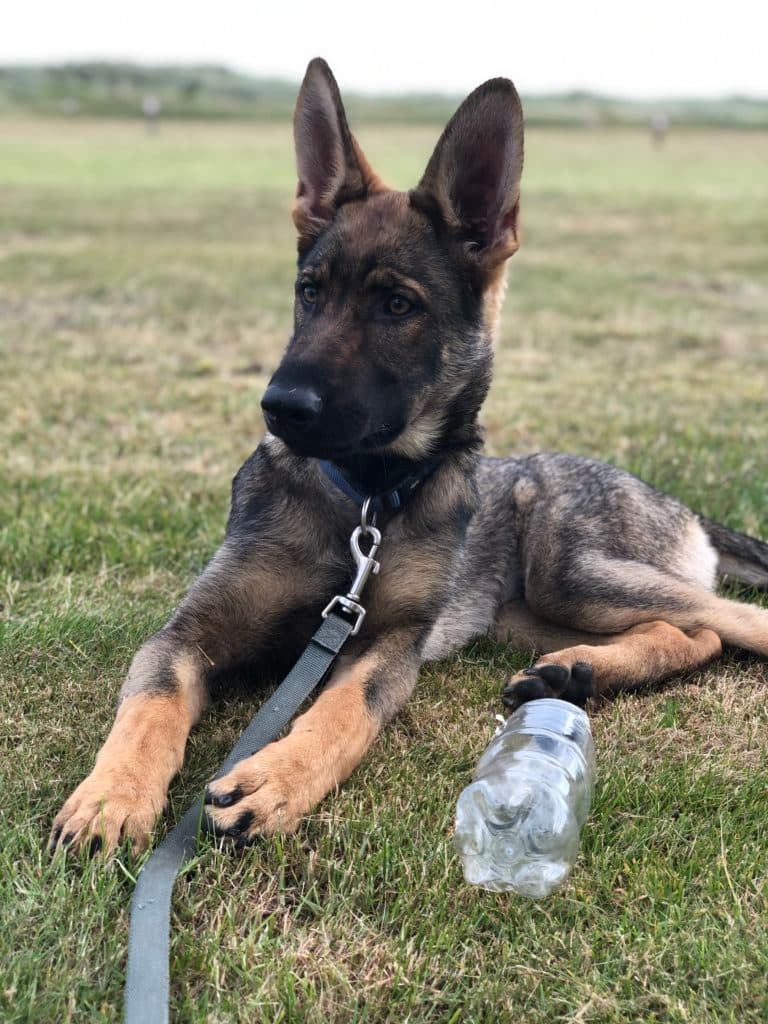
De siste 10 dagene har jeg kjørt en liten 10 Dagers Challenge på «Bli liggende» med schäferen Cuba (15 mnd).
Morten Egtvedt