Canis Clickercamp – Day 4
Today we worked a lot on teaching the retrieve to several of the dogs.

7. juli 2015 · 4 min read
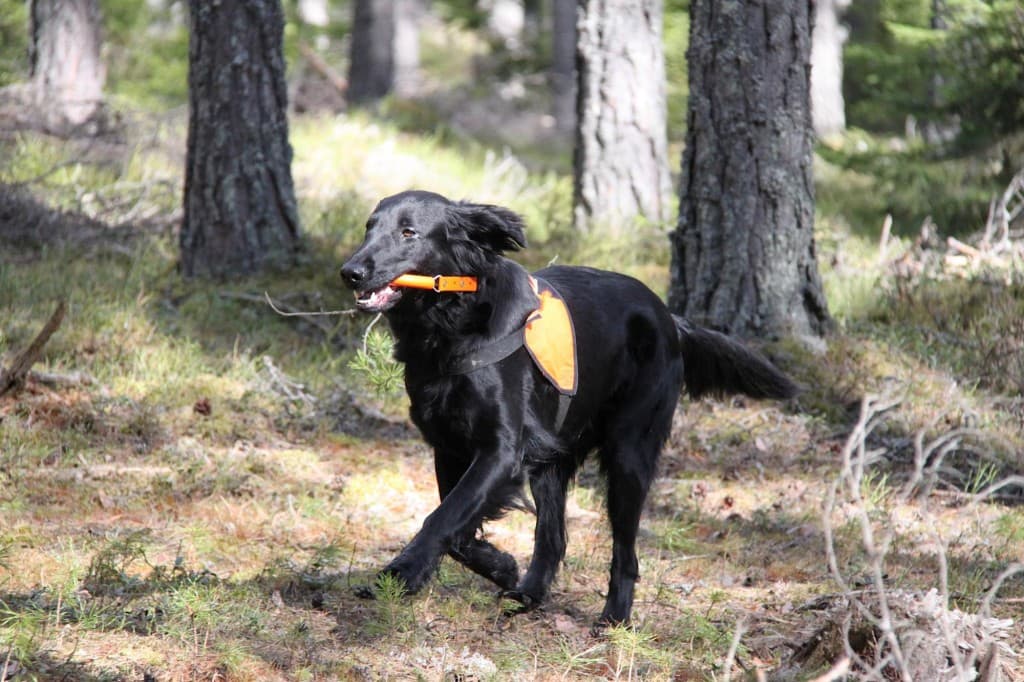
When I teach retrieving, I teach course participants that it's smart to alternate between three variants when it comes to retrieve alert:
- Direct reward
- Loose bite
- Firm bite
I recommend alternating between all three variants even after the dog has learnt to alert with both loose and firm bite. My ideal is that when the retrieving dog reaches a decoy, it should be able to
- go straight into direct reward if the decoy clicks (and then starts rewarding),
- take the loose bite if there's a loose bite on the ground in front of the decoy, OR
- take the firm bite if the decoy doesn't click and reward – and there's no loose bite nearby either.
I want the alternation between these three variants to be seamless for the dog. The dog should alert just as well with the firm bite even if it's done direct rewards on the last 10 finds.
So what's the reason I don't just run firm bite for every single find once the dog has learnt this? There are two main reasons:
- Running direct reward means you can concentrate exclusively on the search during some sessions. When the dog doesn't need to alert, you can run many more finds before the dog gets tired, and we eliminate some error sources if the dog isn't quite certain about certain aspects of the search or the alert yet.
- Running direct reward or loose bite prevents distance alerts, and stops the dog from becoming too trigger-happy on the firm bite.
Many are sceptical about alternating in this way, because they believe the dog will get worse at alerting with the firm bite if it sometimes gets direct reward from the decoy. I understand why people think this. But still – it's a misunderstanding.
Your dog's firm bite alert won't get worse or better because you run direct reward occasionally. Your alert is as good as it is, and this doesn't change whether you run direct reward or not. If your alert isn't well enough trained yet, direct reward can sometimes lead to the dog not taking the firm bite after running several direct rewards in a row – this is correct. But your alert is exactly as good as it was before. It's just that the weakness now comes to light.
If your alert is well enough trained, however, your dog will be able to alternate completely seamlessly between direct reward and firm/loose bite alerts – even within the same training session. With such dogs you can alternate completely unpredictably, and it's never a problem. Instead, you see the retrieve alert become very reliable. Distance alerts are effectively prevented, and you get in the important 2-second safety margin we write about in «Rundering i teori og praksis».
Finally, here are some simple tips for you who want to alternate between all three variants with the best possible results and the least complications:
- Start early training the retrieve alert (on the training ground) in parallel with starting search training in the forest. Don't wait until the dog is 2 years old and has been retrieving its whole life with direct reward in the forest before then.
- Back-chain the retrieve alert!
- Get good flow in the retrieve alert. It should be overtrained and quality-assured according to all the rules of the art so the dog (almost) never makes mistakes when you take the alert out into the forest.
- The decoy should always click before starting (direct) reward. This makes it even clearer for the dog when it should alert, and when it should go straight into play. When the dog alerts with loose or firm bite, the decoy clicks instead when the dog comes out on the find.
- Always let the retrieve collar hang on the dog even when you're running direct reward so the dog gets used to this.
- Find the balance: If the dog is very trigger-happy on the alert, you run more direct rewards. If the dog finds it a bit difficult to take the firm bite, you run more repetitions with firm bite until the dog gets flow in the alert behaviour.
Use common sense, and you'll go far. Good luck with your alert training!
Written by
Morten Egtvedt
Hovedkontor · Trondheim
Morten Egtvedt founded Canis in 1998. He has written three books and trained over 400 dog instructors in clicker training and reward-based dog training.
Se profil og andre artikler →More to read
· 2. juni 2020 · 4 min
10 dagers challenge på Bli liggende
De siste 10 dagene har jeg kjørt en liten 10 Dagers Challenge på «Bli liggende» med schäferen Cuba (15 mnd).
Morten Egtvedt
· 5. september 2019 · 2 min
Den første treningsøkten
I skrivende stund har vi hatt Cuba i 2 måneder og 1 uke, og grunnferdighetstreningen pågår for fullt.
Morten Egtvedt

· 28. januar 2018 · 2 min
Kriterieplan for å bli en rå klikkertrener
Jepp, det er mye å lære for en ny klikkertrener. Men mange har gått veien før deg, og her er stegene du erfaringsmessig trygt kan følge. Kos deg med treningen og stol på prosessen!
Morten Egtvedt