
Why keep the treat hidden in your pocket?
One of the first things I teach my course participants is to keep the treat well hidden in their pocket while training – until (at least 0.3 seconds) after the click.

28. september 2018 · 6 min read
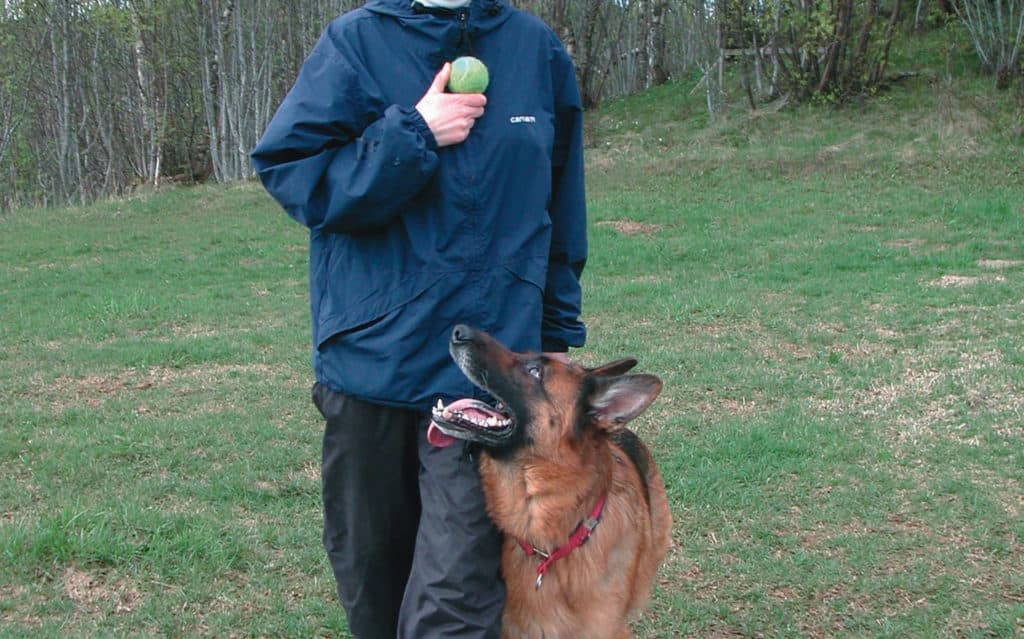
The behaviour should be performed by the dog first – then the reward appears in the light!
There are (as always) some exceptions to this rule. But let me be very clear: Most cases I see where trainers hold treats or toys visibly in their hand during training are NOT about strategic exceptions to the rule, but much more about downright habits the trainer has developed. Unfortunately often at the expense of long-term results. Let me explain a bit further.
When we train a specific behaviour, we never train just the behaviour itself – we always train the behaviour in a context. That's why we always analyse both
A – B – C (antecedent – behaviour – consequence)
…and not just B, when we want to understand a behaviour.
Put another way: It doesn't help that the behaviour looks good if it only occurs in a completely different situation than where you actually need it! (for example, visible rewards are not allowed in competitions…)
A context (situation) consists of several different stimuli (the trainer's movements/words/sounds, visual impressions and smells in the environment etc). When a behaviour is reinforced during training, we don't just reinforce the behaviour – we reinforce the behaviour in the presence of specific stimuli (Antecedents).
When a behaviour is reinforced in the presence of one (or several) stimuli, these stimuli will quickly gain stimulus control over the behaviour. Stimulus control is defined as "the behaviour is performed more often when stimulus X is present, compared to when stimulus X is not present".
We don't answer the phone when it's not ringing – only when it rings first. We don't check the postbox late in the evening (if we've collected the mail earlier in the day).
Similarly with visible versus invisible rewards. If a behaviour during learning is reinforced many times when the trainer has the reward visibly in their hand, this will be VERY prominent stimuli that quickly gain stimulus control over the behaviour. Of course this can be phased down as training progresses, and the faster you remove the visible reward, the less risk of dependency there is. So you CAN get away with some sloppiness in the beginning of training.
But my question (which is concerned with optimising dog training as much as possible) is: Why would anyone use more help than necessary that has to be removed later (and which the dog can become dependent on) WHEN THIS IS NOT NECESSARY? It's so INCREDIBLY easy to keep the reward hidden in your pocket, and only bring it out after the click?
Or – is it actually that simple? Am I perhaps too quick here…?
On reflection perhaps I'm taking the problem a bit too lightly. It IS actually not easy to always have the reward hidden in your pocket – when you've once become used to holding it ready in your hands. It's like saying that "it should be easy for a gambling addict to use their money on better things than gambling it away", or that "it should be easy for an alcoholic to stay away from the bottles". So I apologise for my lack of empathy – I realise it's not that simple…
There are two main reasons why it's so addictive to hold the reward in your hands once you've got a taste for it:
- It saves work (and humans are after all rather convenient creatures). And the less often you hide the reward in your pocket, the more laborious it will feel to you on those occasions you actually do it right, since you'll lack good mechanical skills in quickly pulling the toy/treats up/down from your pocket. And the poorer mechanical skills you have in pulling the reward up/down, the more pleasant it will feel to instead have the reward easily accessible in your hand.
- And most importantly: The more often you go around with the reward visible, the better your dog will perform when the reward is visible (compared to when the reward is hidden). The dog performing worse than usual is often very uncomfortable for dog trainers. This means that correct behaviour (hiding the reward in your pocket) is actually punished on the occasions it occurs (your dog trains you just as much as you train your dog…). And at the same time – the dog (seemingly) performing well, being keen and executing the behaviours with speed and intensity is VERY reinforcing. It's like heroin for dog trainers. No wonder anyone can get hooked…
If from the very beginning you're careful to always keep the reward hidden in your pocket, this doesn't become an issue. When you've never been hooked on the stuff, you don't have any withdrawal problems either. In addition, you'll then have such good mechanical skills in pulling the reward up/down from your pocket that you barely think about it – it's just a completely natural part of training that more or less runs itself. And not least – your dog performs just as well/keenly/intensely with the reward invisible anyway – that's what it's used to.
– "But I can't reinforce in the right position if I don't have the reward ready in my hand", you might think.
Well, that's what we have the CLICKER for in the first place! The clicker is a "bridge" between the moment you MARK correct behaviour, and when the reward is delivered 1-3 seconds later. That's exactly what the clicker is made for! Reward placement is something you can use IN ADDITION to the clicker – not as a replacement for it.
As a clicker trainer you actually have to dare to TRUST THE CLICKER. If you're a reward placement control freak this will be difficult at first (not least because you've probably been sloppy about holding your working position after the click for years, so your dog doesn't listen much to the click anyway). It's easy to get into bad company once you're on a roll.
But to all who are hooked on visible rewards – know that there is hope! And it begins with making the choice that from now on I'm going to stay sober and train as optimally as possible (with the reward hidden!). You decide to tolerate the small discomfort it involves in learning the new mechanical skills you need while it's happening – and before long you'll have developed such good flow with the new mechanical skills that you won't think about it anymore.
– "But what if we're training with reverse luring – doesn't the reward have to be visible then?" Good question! I'll probably write more about reverse luring later… 🙂
PS: A bit of dry training can kickstart the new good habits! Here are a couple of exercises you can run on your own before you bring out the dog. Start controlled with slow movements, be careful to keep your hands still until after the click – and let the tempo increase naturally as your movements get better flow.
Written by
Morten Egtvedt
Hovedkontor · Trondheim
Morten Egtvedt founded Canis in 1998. He has written three books and trained over 400 dog instructors in clicker training and reward-based dog training.
Se profil og andre artikler →More to read
Klikkertrening · 26. mai 2024 · 7 min
Belønningsplassering
Det viktigste er å klikke presist. Men i mange tilfeller kan du også effektivisere treningen ytterligere ved å servere forsterkeren på en spesiell måte etter klikket.
Morten Egtvedt

Læringsteori · 28. juli 2026 · 1 min
Podcast med Morten Egtvedt & Lundqvist Hundeskole
Ingerid og Vegard fra Lundqvist Hundeskole er på kursturné i Midt-Norge, og benytter sjansen til å svippe innom Morten Egtvedt fra Canis Hundeskole for hyggelig besøk og podcast innspilling.
Morten Egtvedt

Filosofi · 22. mai 2026 · 5 min
Vitenskapelig hundetrening?
Jeg tror tiden har kommet for å avkrefte en myte, og det kommer muligens til å gjøre litt vondt for mange. Det gjør ofte vondt å skifte oppfatning om noe, men det går over og man kommer som regel klokere ut av det.
Morten Egtvedt