
Treat Placement
The most important thing is to click precisely. But in many cases you can also make your training even more effective by delivering the reinforcer in a special way after the click.

26. mai 2024 · 8 min read · Canis Hovedkontor · Canis Trondheim
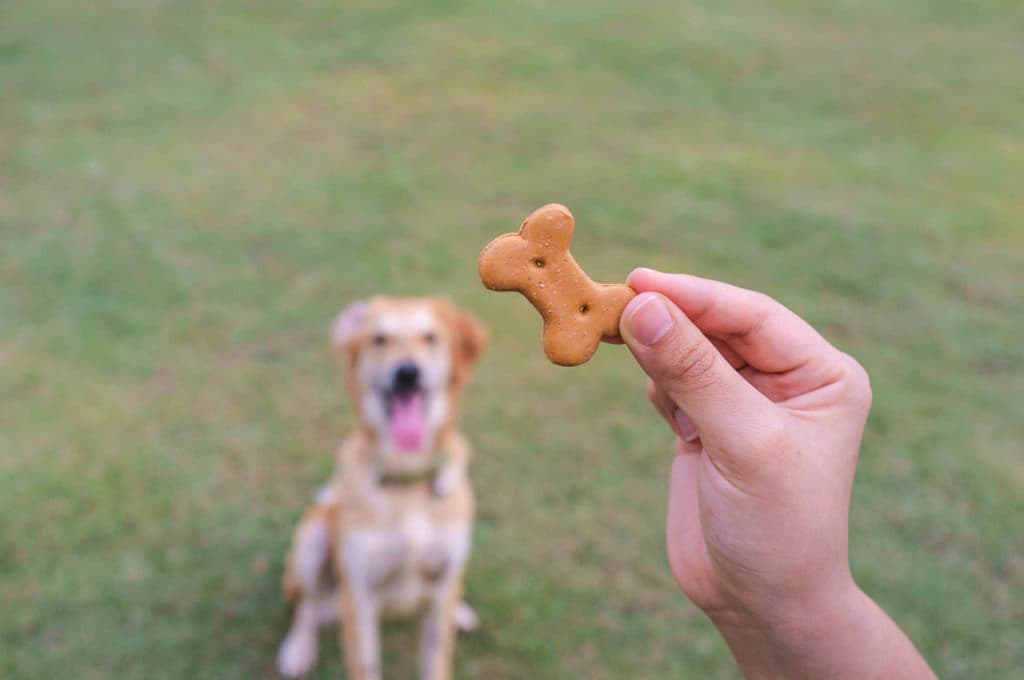
There are roughly 4 different categories of "reward placement". You can see examples of all of them executed in practice in this short online course on Canisakademiet.no.
Here comes a short description of the four categories (with a bonus category thrown in).
1 – Reward in position ("room service")
This means delivering the reinforcer whilst the dog remains in the position it was in when you clicked (instead of coming to you when you click). This is a common way to reinforce, for example, when you're training "down". We click the moment the dog lies down, and deliver the reinforcer whilst the dog is still lying down.
If we're training send-aways to a square, "reward in position" can involve clicking the moment the dog runs to the correct point within the square, and then running up to the dog and rewarding it within the square, or possibly throwing a ball directly to the dog.
The purpose of this type of reward placement is in a way to get "2 behaviours for the price of 1 reinforcer". We reinforce the actual behaviour we're training (e.g. down) with the click, and additionally reinforce "staying in the same position" with the way we deliver the reinforcer.
2 – Ready for the next repetition
This type of reward placement involves clicking for the correct behaviour, and then using the reinforcer to manoeuvre the dog into the correct position for the next repetition. This can involve playing with the dog whilst moving to the next starting point. It can also involve delivering the treat in such a way that you turn the dog's head in the right direction so that it's easy for the dog to start the next repetition once it has swallowed the treat.
Sometimes "ready for the next repetition" and "reward in position" will be the same thing. If you're training "stay down", for example, you can reward whilst the dog is lying down. This is "room service", but at the same time it's also "ready for the next repetition", since the dog should also start the next repetition lying in the same place. The same applies, for example, when you're training pivots on the spot during free heelwork.
The purpose of this type of reward placement is to reduce dead time and achieve better "flow" in training. When the dog is constantly alternating between reinforcement – work – reinforcement (without dead time and unnecessary movements in between), training becomes significantly more effective, and you avoid the dog doing other (unwanted) things during the gaps between repetitions.
3 – Direction expectancy
Direction expectancy involves delivering the reinforcer in a particular direction, with the aim of creating an "expectancy effect" which in turn influences the dog's behaviour in the desired direction. Perhaps the most common example is delivering the treat slightly to the left during training of free heelwork/starting position. The goal is for the dog eventually to expect the treat to come from the left hand to the left, so that it doesn't pull forward in front of the handler's legs and thus moves unevenly.
Other common examples of direction expectancy are reinforcing send-aways by clicking and then throwing a ball in the dog's direction of travel. This will eventually influence the dog's behaviour in a specific direction.
Direction expectancy is often very effective for "fine-tuning" the dog's behaviour, and can be a nice "shaping shortcut" in several situations.
4 – Preparing the next step in the chain
The final category involves reinforcing in a way that makes it easier to add the next step in the chain later. This is a relatively uncommon form of reward placement, but it can certainly be used in certain cases.
An example is send-away to a cone (where the dog is later to be sent on from the cone and a further 25 metres to the square). You can then train the actual send-away to the cone by placing a distance reinforcer (ball, treat bowl or similar) 20-30 metres to the right or left of the cone. The dog then first runs to the cone, and when it gets a click for standing at the cone the handler clicks and says "go on", whereupon the dog sprints to the right/left to get the reinforcer. The dog becoming used to running (fast!) past the cone can in a way prepare it for what it should later learn, and maybe save us some extra repetitions.
However, this type of reward placement should not be used instead of properly back-chaining the exercise. It's primarily a supplement that can be used from time to time, whilst many repetitions will also take place with other types of reward placement.
5 – No specific reward placement
The subject of reward placement has become such a common technique to use in recent years that I'd like to make a case for a fifth category of reward placement – namely "no specific reward placement". This means you click for the correct behaviour – and then reward "in some way or other", which may well vary from one time to the next, and which has no extra purpose other than to deliver the reinforcer to the dog.
An advantage of rewarding "unstrategically" and in a varied manner like this – for example, sometimes by throwing the treat to the dog, sometimes giving it by hand, sometimes running off so the dog has to catch you up, and so on – is that the dog learns to perform the behaviour in slightly varied situations, and not just when we're running a very specific form of reward delivery.
When you don't use reward placement, it also necessarily forces you to base your training on precise clicking and sensible criteria – in short, good, old-fashioned clicker training!
Variation is good!
And it's precisely this matter of VARYING that's often good advice when it comes to reward placement. Early in the learning process, it can be wise to use the same type of reward placement fairly strategically (for example direction expectancy) to make the actual learning easier. But the ultimate goal should be that the dog can perform the behaviour precisely regardless of which direction the reinforcer comes from, so you can gradually reward without any particular direction – or perhaps even deliberately in the opposite direction, to quality-assure the behaviour (e.g. reverse luring).
"Ready for the next repetition" is something you can very usefully employ a lot to make training efficient. But remember also to train behaviours without always having positioned the dog with its nose in the optimal direction every single time! The dog should, for example, be able to "go to the mat" without you always turning it in the optimal direction every single time – the dog should also be able to stand facing you, and voluntarily turn 180 degrees to go to the mat. So again – variation is important, especially once we're past the early stages of training.
"Reward in position" is nice to use, for example, whilst you're teaching the dog to hold a stay position stably, but eventually it's also wise to vary by clicking and letting the dog "pop up" and take the reward. This means you get better quality-assurance of, for example, stimulus control. The dog should be able to, for example, "stay down" right up until it gets a click or instruction to get up, even if it "expects" to pop up.
If you always train a particular behaviour ONLY with a particular type of reward placement, you can frankly risk your reward routine becoming such an integrated part of the behaviour that the dog simply gets problems performing the behaviour if you suddenly reinforce in other ways (or possibly can't reinforce in a particular way).
So the main rule is "reward placement first for easier learning and better precision – then variation to achieve the best possible GENERALISATION.
The click is most important!
Another thing that's very important if you want to clicker train effectively is that you don't make the reward placement more important than the click. MAIN FOCUS should be on
- clicking the correct behaviour precisely
- maintaining the working position for AT LEAST 0.3 seconds after the click
Only when these two are fulfilled can you then possibly place the reward in a specific way to put the icing on the cake and get the bonus effect.
What unfortunately happens very often when dog trainers become overly focused on reward placement is that they
- Begin reward movements before/simultaneously with the click (i.e. break the working position too early)
- Click imprecisely
What then happens is that the click simply loses its effect, since the dog learns to watch the handler's reward movements instead of listening for the click. The result is a vicious circle where the handler doesn't "trust the clicker" (and maybe stops using it altogether), and instead begins to place even greater emphasis on reward placement, and so on. And suddenly you've practically stopped clicker training…
So the moral is: "Good clicker basics first – whilst reward placement is the (important) icing on the cake!"
Written by
Morten Egtvedt
Hovedkontor · Trondheim
Morten Egtvedt founded Canis in 1998. He has written three books and trained over 400 dog instructors in clicker training and reward-based dog training.
Se profil og andre artikler →More to read
Filosofi · 22. mai 2026 · 5 min
Vitenskapelig hundetrening?
Jeg tror tiden har kommet for å avkrefte en myte, og det kommer muligens til å gjøre litt vondt for mange. Det gjør ofte vondt å skifte oppfatning om noe, men det går over og man kommer som regel klokere ut av det.
Morten Egtvedt
Klikkertrening · 19. mai 2026 · 3 min
Instruktørutdannelse hos Canis
Hvis du har lest bøkene «klikkertrening for din hund» eller «Lydighetstrening i teori og praksis», har du lært om betydningen av fokusere på 4 ting for å effektivisere treningen din (eller til dine kurselever):
Morten Egtvedt

Læringsteori · 10. mars 2026 · 3 min
Bruk av feil-signal forsinker treningen
I Psychology Today kan vi lese en veldig bra artikkel som tok for seg en problemstilling hundetrenere har diskutert i mange år.
Morten Egtvedt