
The Important Puppy Game – The Art of Raising a Socialised Dog
Finding good playmates for your puppy

23. mai 2015 · 6 min read
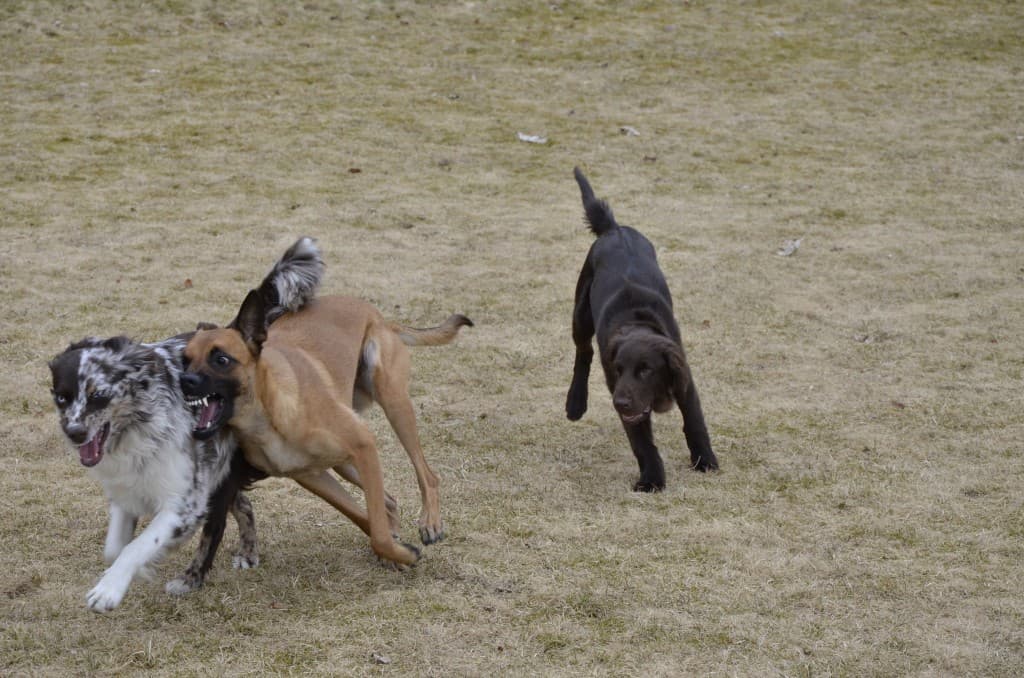
When I'm selecting which dogs should have a proper conversation with my dog, there's one thing that gets top priority: the dogs I use must be friendly, social and confident in their communication. A dog that is confident in itself, and confident in using their full range of language, is a better teacher of language and behaviour than a dog that is so insecure it needs to put a little puppy in its place. A dog that is confident that small signals work doesn't need to use capital letters to communicate effectively. And a puppy that learns to respond to small signals rarely needs to be put in its place. Dogs learn good dog language by spending time with good communicators, just as they become poor/helpless communicators by spending time with dogs that don't respect signals or have themselves learned that small signals don't work.
Dogs that already use big signals (barking) for trifles from the beginning, I avoid (surprisingly many think it's healthy for a puppy to be barked at by a complete stranger). Dogs that are so insecure that they use the puppy's weakness as an opportunity to assert themselves are naturally also something I steer clear of. I also avoid dogs I KNOW have spent a lot of time with bullies/aggressive dogs, even if I don't SEE anything concrete myself. There can be quite a lot of tiny signals that I don't pick up on, but which are clear enough for the dogs.
If I have the chance, I try to choose different breeds/sizes/colours/sexes. If the selection of friendly dogs is limited, good communication skills/social behaviour ranks higher than diversity on my priority list. There's no point in exposing the puppy to lots of dogs just for the sake of it—the meetings should be positive experiences for the dogs. Occasionally accidents happen, and the puppy has a rough experience with a dog. Then it's major repair work for the friendly friends: they get the task of rebuilding confidence in the little one. If I have contacts with a social dog that's a bit like the dog that was rough, I use that for all it's worth.
Play development between dogs
I want my dog to have a large spectrum of play types in their repertoire. The reason for this is that it increases the chance that they can get along with a larger number of dogs. Dogs that only prefer one type of play can easily become unpopular with other dogs, especially if the preferred play is perceived as rude by other dogs. A dog that is perceived as a bully by other dogs naturally gets fewer friends (not many want to let their dog get bullied again and again). It's good that the dog gets to play their favourite play with someone they feel safe with, but in the early stages I spend a lot of time with dogs that play several other types of play, so that it also becomes really cool. If my dog mostly wants to wrestle, I let them play a lot with dogs that are good at starting chase games. If the dog only wants to run, I can let them play a lot with someone who is good at playing with objects, and so on. The more dogs my dogs can get along with, the more freedom they can have. Going for group walks with 15 loose dogs that are harmonious and confident with each other is a wonderful experience. I'm also confident that it enriches the dogs' social lives to have many friends.
When Tiki was in daycare with Easy (a Mastiff), one of the things that really made it work was that the two could play countless different games, and they constantly switched between them. They could have running sprees, and then after a little while lie and snuggle with the teeth wrestling game, then the next moment they could collaborate on a chew toy or a toy, before they could run a few rounds again. This way they could play for quite long periods without getting stressed. In the video above you can see some of that switching. Even though there are lots of teeth and noise, their bodies are completely relaxed, and you can see that Easy is constantly holding back (self-handicapping), and that Tiki is completely confident. You can also see that Tiki bites quite a bit (including on the paws), and that it's uncomfortable for Easy. She is still patient, and finds creative ways to solve it, instead of barking.
When two mates play together, there can certainly be temperament, as long as it's clear that both parties are in on the fun, and understand that it's play. That they trust each other and switch roles in the play is a good sign. If it looks like one is having a lot of fun while the other isn't having fun, you need to think carefully about what's happening. Maybe it's that one becomes uncertain about elements of the play, while otherwise it's all fine—then you can try to step in and guide just the part that's not working so well.
What makes my warning lights flash?
Sometimes you just get the feeling that something is wrong. The things that make my warning lights flash are:
- When a puppy in a social setting clearly doesn't relate to the others (Grisha Stewart talked about the famous elephant in the room). Such a puppy isn't doing well in that situation, and needs to spend time only with safe dogs that build them up.
- If the play is one-way, and it looks like only one party is having fun (especially bad if the one having the most fun is also the strongest party)
- If one of the parties tries to slow down/dampen, but isn't being heard (i.e. poor language skills for dummies). They should respect each other even if they're excited. If they can't manage that, they might need help taking a break.
- If I know that my puppy has had an unpleasant experience, and then uses the same tactic when they themselves meet a weaker party (then I try to prevent them from getting better at it, and instead reinforce good choices).
- If I have confident adult language-strong dogs around that react, even if I don't see anything wrong, I use them as a barometer. They pick up on nuances much faster than I can.
When I see any of these warning lights, what action I take varies. If it's just small stuff, things like stepping in more actively to guide the play (directing pauses, reinforcing good choices, facilitating the environment) can work. If it's really flashing red, like in the first bullet point, I would have solved it by being really strict about who the puppy could play with, in addition to working with exercises/activities that build confidence. If I can solve it just with the help of good helper dogs, then I'm still very grateful for that. Not many can match a confident communicator in training skills.
More to read
Grunnferdigheter · 6. oktober 2020 · 1 min
Bakpartskontroll på target
Her kan du se hele økten og hvordan jeg gradvis høynet kriteriene underveis. Så lite av gangen at hun fortsatt klarer å gjøre riktig, men samtidig så mye at det går fremover.

Grunnferdigheter · 6. oktober 2020 · 1 min
9 uker gammel valp lærer utgangsstilling på to økter
Jeg gjør noen feil underveis, klikker for ting jeg ikke burde klikket for osv, men det gjør ingenting så lenge jeg blir oppmerksom på det og justerer deretter.

Grunnferdigheter · 24. august 2019 · 2 min
Første økt med doggie-zen
Vi kan kalle dette for Cuba´s første «offisielle» treningsøkt med DZ (hun er 6 mnd gammel og vi har hatt henne i under 2 mnd foreløpig).
Morten Egtvedt