
Backwards Chaining of the Stairs – with Start Button Behaviour
Today we had the fifth session of «Brukshundstigen», since we started teaching this exercise a couple of weeks ago.

10. juni 2021 · 6 min read
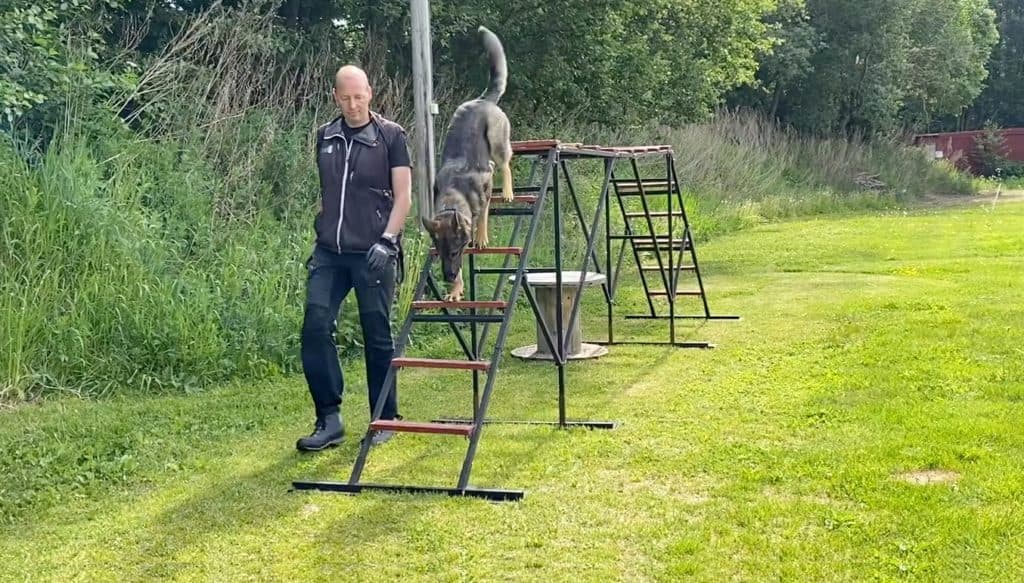
Our main strategy is straightforward: backwards chain the entire ladder. I started by lifting her onto the final step, and have been gradually and carefully moving her further along the ladder as I see she's ready for it. Until the dog is confident walking across the whole ladder, we click the moment she stops (and freezes) with her front paws on the last step (we'll also add some free rewards at the bottom when she comes down from the ladder later, but we'll save that for next time).
We've been taking things slowly and carefully, with progress of 1–3 steps per session. In this fifth session, we made it all the way back to the start of the "flat" section of the ladder. In other words, 2/3 is done, and we only have the charm phase left (in sessions 6 and 7 if all goes to plan). Training went very smoothly today, so I probably could have finished the entire ladder if I'd run a few more minutes. Instead, I chose to collect some "adult dog trainer points" and ended the session while everything was going perfectly. It's easy for the dog to trip on a step when she starts to get tired, and there's no need to introduce that kind of sloppy work into the learning process.
Using "start button behaviours"
The most interesting thing about today's session was that it became a really nice demonstration of using "start button behaviours". A start button behaviour is a "voluntary" behaviour the dog uses to signal to the handler that they're "ready to start the next repetition". You could think of it as the opposite of you having to nag the dog to get going – instead, it's the dog who nags you (or rather, "politely asks") to begin training.
Good clicker training includes (almost) always "start button behaviours", where the dog somehow takes the initiative to start training. Even when you're training behaviours under full stimulus control, there's often a voluntary start button behaviour involved. The fact that the dog takes the initiative and in a way "drives training forward" is absolutely fundamental in clicker training (much more important than the clicker itself!).
There are several advantages to using "start button behaviours" in training:
Firstly, the start button behaviour is often a behaviour we want, and which we therefore want to reinforce. An example might be when the dog voluntarily moves into a starting position and stares up at us "to get us to start". The fact that we can reinforce this starting position by initiating the activity means we strengthen this behaviour without necessarily needing to give the dog praise/ball/treat every time she does it (we can instead save these reinforcers for the "main exercise" we're training). This type of start button behaviour can advantageously be a behaviour you've trained thoroughly separately beforehand. By using behaviours we want as start button behaviours, we reinforce two behaviours for the price of one, in a sense.
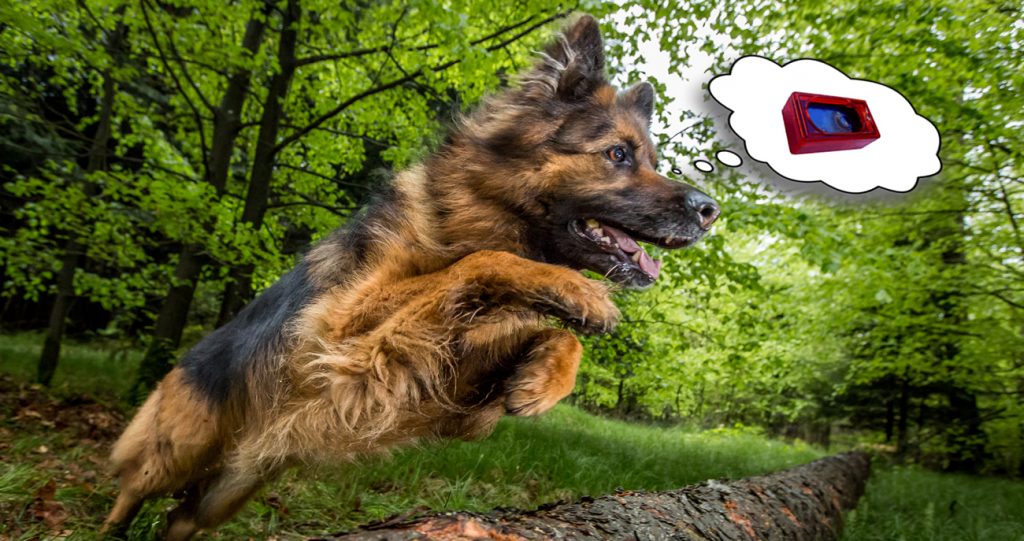
Secondly, start button behaviours are often useful as a "diagnostic tool". If the dog continues to offer a start button behaviour that's only reinforced with "initiating the activity", it tells us that the training we're doing is clearly an effective reinforcer. Put simply, the dog "wants" to do it! If not, she wouldn't have offered the start button behaviour in the first place. This point is particularly relevant in connection with this training session on the ladder (and for example with "handling training"), where there's a certain risk that the dog might find the training unpleasant. It could potentially be a bit scary both to be lifted up and to be on the ladder before she's learned it properly!
The fact that the dog continues to offer the start button behaviour – and also increasingly seems to get better at offering this start button behaviour – is a clear signal to me as a handler that my criteria are at least reasonably sensible, that the reinforcer I'm offering is sufficiently effective, and so on. When the dog can control when she's "ready" to start the next repetition, it reduces the chances of me "pushing" the dog to do things she's not ready for. Animals generally like to have some control over their environment, and start button behaviours definitely give them more of that – and it also makes the training a notch more reinforcing.
For start button behaviours of this second type (which are used where there's a certain risk that the dog might experience the training as unpleasant), it's often an advantage to use start button behaviours that DON'T have a heavy reinforcement history from before. It's often more ideal to choose a new behaviour the dog hasn't done much before, and ONLY reinforce this start button behaviour with "initiating training" from the very beginning. By doing this, the behaviour simply becomes a more precise diagnostic tool. It's easy to imagine that if you use, for example, "hand target" as a start button behaviour and the dog is already fluent at this from before, the dog could very easily end up offering the hand target quite regardless of whether she's "ready" for the next repetition of, say, nail clipping or not…
What is the start button behaviour…?
In this film of training on the ladder, I use a fixed start button behaviour (which has NOT been reinforced separately in other contexts). I don't say what this behaviour is. Watch through the film yourself and pay attention to what happens right before I lift her onto the ladder, and I'm quite sure you'll spot the start button behaviour pretty quickly.
An important point regarding start button behaviours is also that if the dog says "no" – i.e. she doesn't offer the start button behaviour clearly/voluntarily, you as a handler should respect this. At one point in the film I take a break of almost 2 minutes because the dog clearly signals she's not ready. Most likely this happened because she was warm/tired, not because of fear of the ladder. But the reason isn't really that important. As long as she doesn't offer the start button behaviour, I won't lift her up. Training becomes much more elegant (and effective) if she genuinely gives me permission (or "bugs me") to start the next repetition.
What are your start button behaviours?
I hope this gave you some ideas you can use. Can you implement more voluntary start button behaviours in your training? Are there any behaviours/exercises where this would be particularly useful?
If you'd like to learn more about training with start button behaviours and clicker training in general, you're welcome to enrol in Canis's clicker instructor course, which starts 18 August 2026. There are still a few places available both as a participant and as an observer. Find out more about the instructor course at www.klikkerinstruktor.no
Written by
Morten Egtvedt
Hovedkontor · Trondheim
Morten Egtvedt founded Canis in 1998. He has written three books and trained over 400 dog instructors in clicker training and reward-based dog training.
Se profil og andre artikler →More to read

Filosofi · 22. mai 2026 · 5 min
Vitenskapelig hundetrening?
Jeg tror tiden har kommet for å avkrefte en myte, og det kommer muligens til å gjøre litt vondt for mange. Det gjør ofte vondt å skifte oppfatning om noe, men det går over og man kommer som regel klokere ut av det.
Morten Egtvedt
Klikkertrening · 19. mai 2026 · 3 min
Instruktørutdannelse hos Canis
Hvis du har lest bøkene «klikkertrening for din hund» eller «Lydighetstrening i teori og praksis», har du lært om betydningen av fokusere på 4 ting for å effektivisere treningen din (eller til dine kurselever):
Morten Egtvedt

Læringsteori · 10. mars 2026 · 3 min
Bruk av feil-signal forsinker treningen
I Psychology Today kan vi lese en veldig bra artikkel som tok for seg en problemstilling hundetrenere har diskutert i mange år.
Morten Egtvedt